
The Metamorphosis
Overview
Franz Kafka’s The Metamorphosis—originally published in German as Die Verwandlung—is a modernist novella first published in 1915. It is also regularly associated with absurdist and existential fiction, although its power comes from resisting any single classification. The opening sentence presents one of the most recognizable images in modern literature: Gregor Samsa, a traveling salesman, wakes after troubled dreams and discovers that he has been transformed into a gigantic insect-like creature, often described in English as a beetle or cockroach. Kafka never explains the cause of the transformation. Instead, he places the impossible inside an ordinary domestic and professional routine, making the everyday world itself seem terrifyingly unstable.
Plot
Before his transformation, Gregor is the principal provider for his family. His father’s business failure has left debts, and Gregor’s earnings support his parents and his younger sister, Grete. Even after waking in his new body, his first concern is practical: he has missed a train and may be reprimanded by his employer. He struggles to move, unlock his bedroom door, and speak in a human voice. A company chief clerk arrives to question his absence, while his family waits anxiously outside. When Gregor finally opens the door, his appearance provokes horror. His speech is no longer intelligible to others, and his father drives him violently back into the room, injuring him.
Gregor becomes confined to the bedroom. Grete initially brings him food and tries to care for him, while the family members return to work: his father obtains employment, his mother sews, and Grete seeks a job. The household later takes in three lodgers. As the family becomes more economically independent, Gregor is increasingly treated as an obstacle and a source of shame. Furniture is removed from his room, threatening the remaining connection to his human identity. Hearing Grete play the violin for the lodgers, Gregor crawls out, moved by the music and hoping to protect her artistic future. The scene instead produces another crisis. Grete concludes that the creature must be removed from their lives. Gregor withdraws, weak from neglect and isolation, and dies alone. Afterward, his family leaves the apartment for the countryside, imagines a more secure future, and notices Grete’s maturation.
Themes and Technique
The novella’s central concern is alienation. Gregor’s physical change makes visible a condition that existed before the event: he has already been reduced by work, debt, routine, and family obligation to an economic function. While he can earn money, he is necessary; once he loses that capacity, the family’s affection becomes conditional and fragile. The story therefore asks whether human worth is being measured by usefulness, productivity, and obedience. It also explores the instability of identity: Gregor’s body becomes nonhuman, yet his memories, anxieties, loyalties, and responsiveness to music remain recognizably human.
Family conflict is equally important. Gregor loves his parents and sister, but he is also trapped by their dependence on him. His father’s authority and violence evoke guilt, fear, and the struggle between obedience and independence. Grete’s change from caregiver to rejecter is not merely a moral reversal; it shows how exhaustion, economic pressure, and prolonged fear can transform intimacy. The bedroom and its door function as physical and emotional boundaries. They separate Gregor from the family, while his unintelligible voice makes genuine communication impossible. Kafka’s calm, precise prose intensifies the horror by treating extraordinary events alongside trains, meals, rent, clothing, and employment. The transformation can be read as a metaphor for illness, disability, modern labor, shame, family obligation, or the experience of becoming a stranger to oneself, but the story does not settle the matter with an official interpretation.
Background and Legacy
Kafka wrote the work in late 1912 and around 1913, during a period when he was employed in insurance work and wrote largely outside office hours. The conflict between a demanding “bread job” and his sense that writing was his true vocation offers an illuminating background to Gregor’s exhaustion and professional entrapment, though the novella should not be reduced to autobiography. Kafka lived in multilingual Prague and wrote in German within a complex Central European Jewish and cultural environment. These circumstances, together with his intense attention to family authority, bureaucratic systems, and social estrangement, helped shape the atmosphere of the work.
The Metamorphosis remains one of Kafka’s best-known and most influential works. It established an enduring literary image and contributed to the wider meaning of “Kafkaesque,” a term now used for situations marked by bewildering authority, oppressive systems, absurd logic, and helpless isolation. Its influence reaches modernist, existential, and absurdist writing, as well as film, theatre, visual art, philosophy, and psychology. More than a century after publication, the novella remains a staple of literary study because its strange premise continues to illuminate ordinary experiences: being valued only for one’s labor, failing to be understood, and discovering that the place called home can become an alien world.
About the Author
Origins and Education
Franz Kafka was born in Prague on July 3, 1883, when the city belonged to the Austro-Hungarian Empire’s Kingdom of Bohemia. He came from a middle-class German-speaking Jewish family. His father, Hermann Kafka, was a merchant, and his mother was Julie Löwy. Prague was a culturally complicated city in which Czech and German identities increasingly competed, while its Jewish population occupied a distinctive position between them. Kafka spoke both German and Czech, but he wrote primarily in German. This multilingual, socially divided setting is important to the background of a writer whose fiction repeatedly presents people as strangers within their families, cities, and institutions.
Kafka attended school in Prague and entered the German Charles-Ferdinand University in 1901. He briefly studied chemistry and Germanic studies before transferring to law, a course that offered a practical professional qualification and a route to employment. He received his law degree on June 18, 1906. Legal training acquainted him with formal procedure, official language, and institutional authority, elements that later became central to the atmosphere of his fiction. His relationship with his authoritarian father was difficult and psychologically formative, though Kafka’s writing transforms personal experience into imaginative and widely applicable situations rather than simply recording biography.
Work and Literary Career
After completing his studies, Kafka worked in insurance. From 1907 to 1922 he served as a clerk in two insurance institutions, carrying out his professional duties conscientiously while regarding writing as his true calling. Office work left him limited time and energy, so he often wrote at night. His diaries and extensive correspondence reveal a life shaped by self-criticism, friendship, literary ambition, and recurring uncertainty about work, love, family, and health. His closest friend, Max Brod, became particularly important to his literary afterlife.
Kafka’s early publications included the short-story collection Meditation in 1912 and “The Judgment” in 1913. He wrote The Metamorphosis in late 1912 and around 1913; it was published in 1915 and became his best-known work during his lifetime. Other important writings include “In the Penal Colony,” published in 1919, and “A Hunger Artist,” published in 1924. His major unfinished novels include The Trial, published posthumously in 1925, The Castle, published in 1926, and The Missing Man, also known as Amerika, published in 1927. Across these works he examined guilt, authority, bureaucracy, family conflict, identity, exclusion, and the individual’s struggle to find meaning in an opaque world.
Illness, Death, and Reputation
Kafka developed pulmonary disease in 1917 and struggled with it for seven years. His illness increasingly restricted his professional and literary life, but he continued to write, read, and correspond. He was intensely critical of his own work and allowed only a small portion of it to appear in book form while he was alive. Before his death he instructed Max Brod to destroy his unpublished manuscripts, diaries, and letters. Brod refused, edited the surviving materials, and arranged for the publication of many works that became fundamental to Kafka’s reputation.
Kafka died on June 3, 1924, near Vienna at Kierling in Klosterneuburg, Austria, at the age of forty. He was buried in Prague’s New Jewish Cemetery. Although he wrote in German and spent most of his life in Prague, he became a central figure in world literature. Critics now regard him as one of the most important and influential writers of the twentieth century. His precise, restrained prose, dreamlike transformations, and depiction of powerless individuals confronting family authority or incomprehensible institutions influenced modernist, existential, and absurdist writing. The adjective “Kafkaesque” has entered international cultural vocabulary, describing situations in which bureaucratic power, absurd logic, anxiety, and helpless isolation combine. Kafka’s lasting reputation rests not only on the strangeness of his plots, but also on his ability to make private fear and social dislocation feel universally recognizable.
StoryFlow
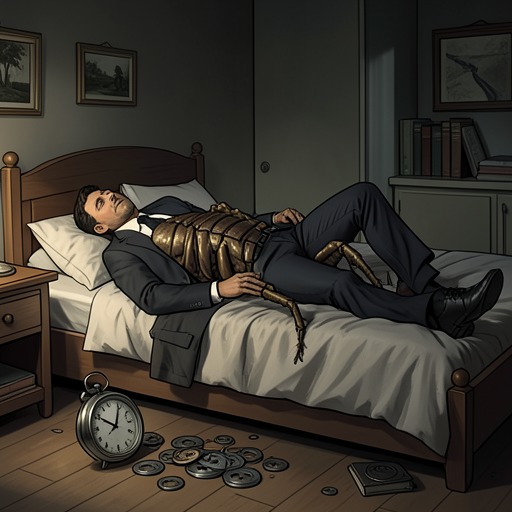
Gregor’s Fall from Provider
This flow traces how Gregor Samsa’s transformation destroys his role as breadwinner and leaves him progressively excluded from family life.
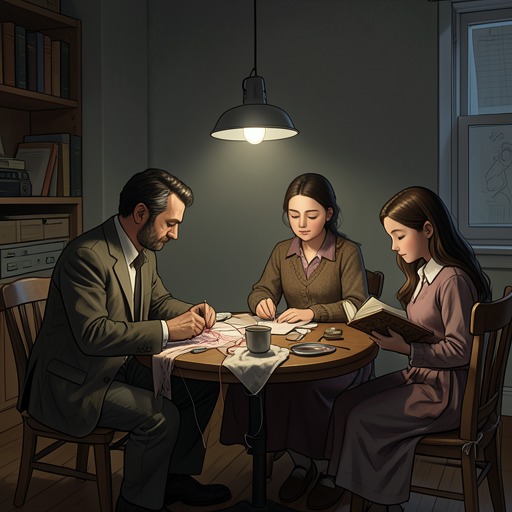
The Family’s Economic Reversal
This flow follows the Samsa family’s movement from dependence on Gregor to reluctant self-sufficiency after his collapse.

The Closing of Gregor’s World
This flow traces Gregor Samsa’s movement from a familiar bedroom to total physical and social confinement.
